
Baroque Nardò in the heart of Salento, Sea Gate on the Ionian Sea
Old town rich in Lecce baroque, marine and protected natural park:
what more could you wish for your holiday in Nardò, a town in Salento?
Nardò Porta di Mare is a large town in the province of Lecce, located in the western part of Salento.
With about 32,000 inhabitants, Nardò is the second largest municipality in the province of Lecce, not only for number of inhabitants but also for territorial extension with its 190 km ².
Around the fifties, Nardò obtained the title of City, therefore, the Neretini, as the inhabitants of this beautiful town are called, specify with great pride to come from the City of Nardò.
Nardò is a unique place, rich in history and monuments of great interest: a beautiful castle, a totally and exclusively pedestrianized historical center, numerous churches, baroque architecture of unique value.
The city has known and hosted different populations and settlements: from the Messapi to the Romans, up to the Byzantines and the result of these contaminations have given life to a fascinating and beautiful city, to visit absolutely.
The hamlets of the City of Nardò
From the Ionian Sea to the hinterland up to the borders of Gallipoli and Porto Cesareo
Contended over the centuries for its proximity to the Ionian Sea, Nardò has many picturesque villages and towns on about 20 km of coast, such as:
- Santa Maria al Bagno;
- Santa Caterina di Nardò;
- Sant’Isidoro;
- Torre Inserraglio;
- il Parco Naturale Regionale Porto Selvaggio e Palude del Capitano;
- Boncore;
- Cenate;
- Corsari;
- Pagani;
- Pendinello;
- Pittuini;
- Roccacannuccia;
- Villaggio Resta.
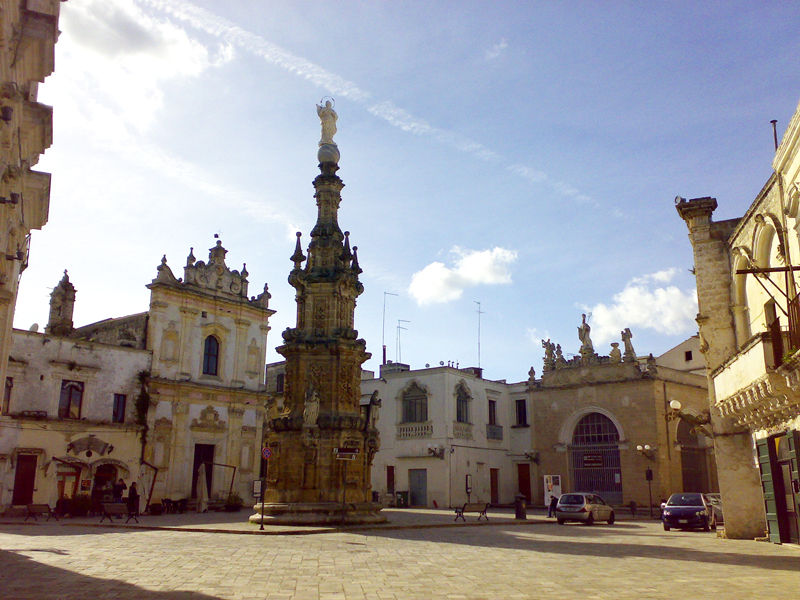
Table of contents
Where is Nardò and how to get there
With its main hamlets Santa Maria al Bagno, Santa Caterina, Sant’Isidoro
The important city of Nardò is located south-west of Lecce, the provincial capital of Salento (which we have already told you about and that we invite you to know with this beautiful experience “The secrets of the Baroque and the typical Salento cuisine) and its hamlets are all adjacent to the urban territory.
Incredibly close to the Ionian Sea, this urban center is close to the state highway, a road from which you can easily reach the most important cities and tourist centers of Salento such as Porto Cesareo, Gallipoli, Maglie, Copertino, Leuca, Ugento, Salve e le Maldive del Salento, Specchia e Presicce and of course Lecce and the airport of Brindisi Papola Casale, connecting Lecce with Brindisi.
Tourists, the curious and the Salento people, can easily reach it. We at Foodismo explain how to do it.
Where is located Nardò Porta di Mare
Nardò is located south-west of Lecce, the provincial capital and its hamlets are all adjacent to the urban territory.
How to get to Nardò from Lecce, the capital of Salento
The distance between the two big cities Nardò and Lecce is 28.8 km driving along the SS101. You can reach Lecce, a railway junction, if you want to reach Nardò by train. Through the South-East railways, then, or the buses of Salento by bus during the summer, you can easily reach your destination.
The distance between Nardò and the nearest airport
The distance between Brindisi, home of the Salento Papola – Casale airport, and Nardò is 62.6 km and can be reached by car along the SS613.
The state road is dual carriageway with a traffic island. Pay attention to fixed and mobile speed cameras to avoid surprises on your return from your holiday in Salento.
How to reach Otranto from Nardò
The distance between Nardò and the most eastern town of Salento, the romantic Otranto is 48.2 km along the SS16 by car. You will spend about half an hour, respecting the speed limits and taking into account the high traffic during the summer season.
After visiting Nardò, we highly recommend you to see Otranto and the fantastic Cathedral of the Holy Martyrs, Santa Maria Annunziata.
Distance between Nardò and Gallipoli
Città Bella is easily accessible in a few minutes.
From the beautiful city, Gallipoli, to reach Nardò instead the route is short: 17, 7 km from the SS 101. Both are the largest and most important cities of Salento overlooking the Ionian Sea.
After visiting Nardò, we strongly recommend you to visit the Purità and the church of Sant’Agata, Virgin and Martyr of Catania.
The distance between Nardò and Maglie
How to get to the elegant little town in the Salento area, known as the Città Salotto
To reach Nardò from the elegant town of the Salento hinterland, Maglie, it is necessary to take the SP363 road for 32.6 km.
After visiting Nardò, we suggest you to do some shopping in the shopping capital of Salento. You will find everything you need: fashion, great brands, household items, toys and cozy places to spend a fun evening.
Nardò – Santa Maria di Leuca
A handful of km away, you can witness the embrace between the Adriatic and Ionian seas
The distance to reach Nardò from Santa Maria di Leuca, De finibus terrae, is 61.3 km.
We advise you to watch the spectacle of the embrace of the two seas, the Ionian and the Adriatic, at sunset, sipping an excellent glass of Negroamaro, the famous red wine of Salento.
History of Nardò Porta di Mare
Nardò has very ancient roots and evidence indicates Prehistory as a period of birth. Near Porto Selvaggio, in the Bay of Uluzzo, in fact, the archaeological discoveries made suggest human settlements in today’s Nardò during the Middle Paleolithic. It is no coincidence that a prehistoric era is called the Uluzziana Era according to the findings in the Grotta del Cavallo (Horse Cave) in the Bay of Uluzzo, a renowned place of the Nardò marinas.Nardò and the Messapi
The arrival of ancient civilizations Around the VII century B.C. the arrival of the Messapi marks the beginning of Nardò as an inhabited centre. Its name in this period is Nerito, from the ancient Greek nar- which means water. Nardò, in fact, like all big cities and as history teaches, was born near the sea, the splendid sea of the present day Santa Maria al Bagno.Nardò and the Romans
In 269 B.C. with the arrival of the Romans, Nardò changed its name to Neretum and became a Roman Municipium and Santa Maria al Bagno became Emporium Nauna. The Romans, then, extended the famous road works carried out in all the conquered territories, also here, building the Via Traiana that flanks the Ionian Sea. After the fall of the Western Roman Empire, Neretum passed into the hands of another great people.Nardò and the Byzantines
Having become part of the territories of the Byzantine Empire, Nardò changed its appearance and welcomed the Basilian monks. The latter escaped from the East, chased in the name of the iconoclastic struggle wanted by the Byzantine Emperor Leo III Isaurico, and took refuge in Salento building characteristic caves on the rocks near the sea.Nardò, the Normans and the Angevins
The Normans conquered the city and its marinas, transferring the Benedictine monks in place of the Basilian monks to the Abbey of Santa Maria di Nerito. Immediately afterwards, the Angevin domination took over, and with them, the system of feudalism. We are around the 13th century. Despite the passage of many civilizations, it was the Byzantines who left the greatest signs of influence. The Greek language and religious traditions remained intact until 1577, when the Council of Trent banned the Greek rite.Nardò and the Acquaviva family
Around the 16th century the feud of Nardò was entrusted to Andrea Matteo Acquaviva and his son Belisario became duke. Philanthropist, patron and humanist, Belisario gives prestige to the city of Nardò which becomes a great cultural centre. The Acquaviva family remained at the head of the Nardò territory for centuries, until the abolition of Feudalism as an organizational system. However, the Acquaviva remain owners of many properties.Nardò and the Carbonari uprisings
Until the 20th century The city of Nardò became the theatre of the Carbonari uprisings in the 19th century. The Phoenix Neretina, the sect born in those years, is the expression and symbol of the Carboneria in Nardò. Following the clashes with the Bourbons and the unification of the Kingdom of Italy in 1861, Nardò became a great municipality and cultural centre of reference for Salento.Nardò e il kibbutz
During the Second World War Nardò, as during the Byzantine period with the Basilian monks, welcomed Jews fleeing persecution during the Second World War. A welcoming and hospitable land, Salento and Nardò helped the fugitives and gave them a refuge, with the construction of a Synagogue for their prayers and, located in the Masseria Mondonuovo, a kibbutz, an association and work centre for the Jews. This gesture of openness and help allowed the city of Nardò to obtain recognition, a gold medal of civil merit in 2005.The symbol of Nardò
The symbol of Nardò consists of a crowned shield that encloses a bull, also with a crown, while with a paw causes a splash of water. Under the shield there is a sentence: “tauro non bovi”, which indicates the identity of the animal, not to be confused with a normal ox.The meaning is easy to interpret: the bull, a sacred animal for ancient civilizations and water, a very important element and very present in the territory of Nardò, the male and the female together, two opposites that attract each other.
Map of Nardò Porta di Mare
What to see in Nardò
The city with its baroque old town and its charming marinas Nardò, a large city in eastern Salento, has a varied artistic and cultural heritage, including numerous churches and elegant buildings. Visiting Nardò is a pleasant and dutiful stop for those who come on holiday in Salento. In fact, those who are lucky enough to visit it for the first time, will be enchanted by the beauty of the city of Nardò: an alternation of marinas, nature, sea, monuments, baroque, patronal palaces, farms, nature, churches, castles, museums. Here are our suggestions for your itineraries to discover Nardò Porto di Mare with Foodismo!The Churches of Nardò
Salento Baroque masterpiecesThe churches of Nardò are about thirty, all scattered over the vast territory belonging to the city. Some of them are really majestic, elegant and rich in details, often of different architectural styles, demonstrating the different settlements and influences that Nardò has experienced, the others are small jewels all to be admired.
The Basilica Cathedral Santa Maria Assunta
In the baroque Old TownLocated in the historical centre of the city, pearl of Baroque art, the Basilica was founded around 1090 by Benedictine monks, who decided to build their place of worship on top of the already existing one of the Basilian monks, settled in Salento after the iconoclastic persecution of the Byzantine era. Currently the architectural style of the imposing Cathedral is Romanesque-Baroque, following the various changes made by the people who inhabited the city. The structure is typical of a basilica, with three naves and decorated with numerous frescoes belonging to different periods. Of particular interest are the Black Christ, made of cedar wood in the twelfth century and the medieval bell tower of typical Angevin workmanship.
Church of San Domenico
In the square of the same name Near the enchanting Piazza Salandra, stands the Church of San Domenico, a 16th century church but rebuilt after the 1743 earthquake. The peculiarity of this church is the difference of the two floors of the facade, built at different historical moments: while the first one is full of columns and details that recall human figures, the other section is simple and smooth, both built in carparo, typical Salento stone.Church of Santa Chiara
Next to the monastery of the Poor Clares Set in a monastic context, the Church of Santa Chiara was born next to the convent of the Poor Clares, founded in the 13th century. In a purely baroque style, the church inside is composed of a single nave and the floor, in grey and white marble, has an octagonal geometric pattern. The chapels house several altars dedicated to Saint Anthony Abbot, the Crucifix, Saint Clare, the Immaculate and Saint Anthony of Padua.Church of San Trifone
The Saint of the miracle of the campaign The Church of San Trifone has a particular history: the neretini, desperate for the invasion of the caterpillars in the countryside, built this church and dedicated it to San Trifone as a request for help. Consistent with the architecture of the old town, the church of San Trifone is also in Baroque style.Church of the Blessed Virgin Mary of Carmel
Romanesque style facade, interiors in classic Lecce baroque style The Church of the Blessed Virgin Mary of Carmel is also part of a monastic complex, one of the largest in the city. Unlike the other churches, however, has a Romanesque style facade but inside has frescoes in a purely baroque style.Piazza Salandra
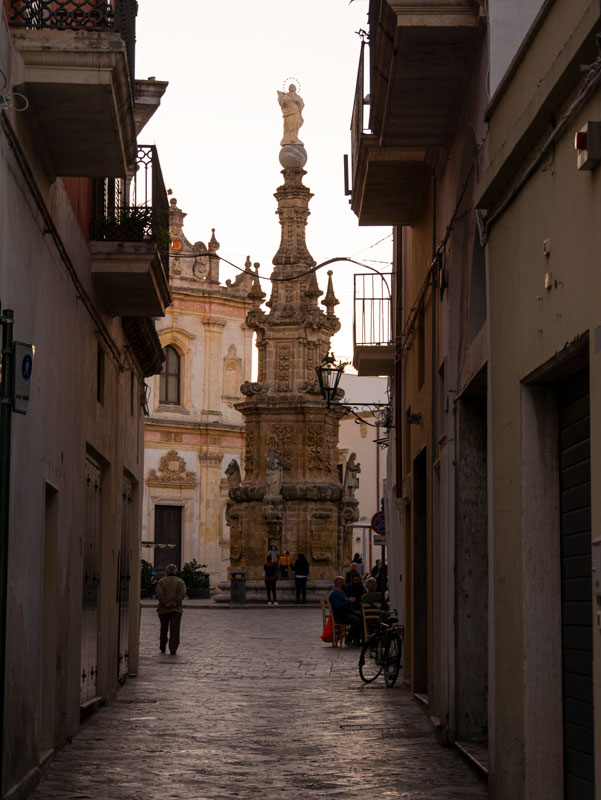
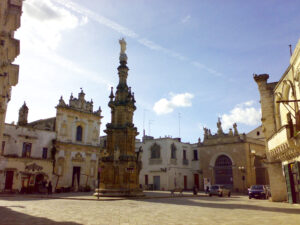
The heart of the historic center of Nardò Porta di Mare, you will be enraptured by its beauty Piazza Antonio Salandra di Nardò is a baroque jewel, full of buildings reminiscent of Lecce, the baroque city par excellence. Once its name was Piazza delle Legne and then Piazza del Municipio. The buildings that characterize this beautiful square are:- the Palazzo della Pretura;
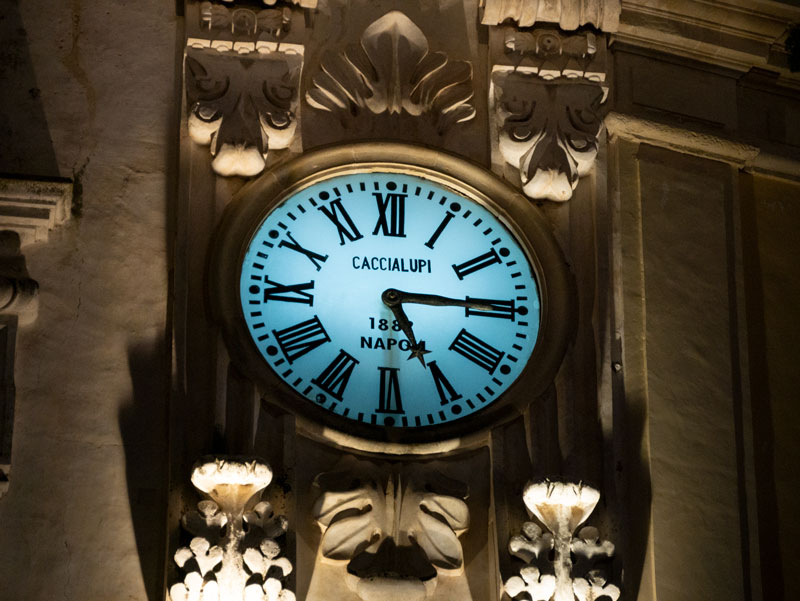
- the Clock Tower incorporated in the facade of the Palace;
- il Sedile, built on the occasion of the foundation of the University of Nardò, in Renaissance style but with late Baroque alterations;
- the Spire of the Immaculate Conception, located in the center of the square, 19 meters high and made of carparo, wanted by the inhabitants as a form of devotion.
Castles, historical buildings and monuments
Nardò has numerous historical palaces and a castle, today known to be the seat of the Town Hall. The beauties that we suggest you to admire are these:- Castello Acquaviva, now the Town Hall of the town of Nardò Porta di Mare;
- Palazzo dell’Università or Palazzo della Pretura;
- Osanna;
- Fontana del Toro.
The Acquaviva Castle
The Acquaviva Castle has a quadrangular plan, with four cylinder-shaped towers positioned at the four corners, a structure also reminiscent of Otranto Castle. Initially surrounded by a moat, the Castle has the typical shape and structure of an Aragonese military construction, in fact, its birth dates back to the 15th century. Flanking it is the Villa Comunale as well as the castle’s park, a large and charming garden with a variety of tree species typical of the Macchia Mediterranea.The University Palace
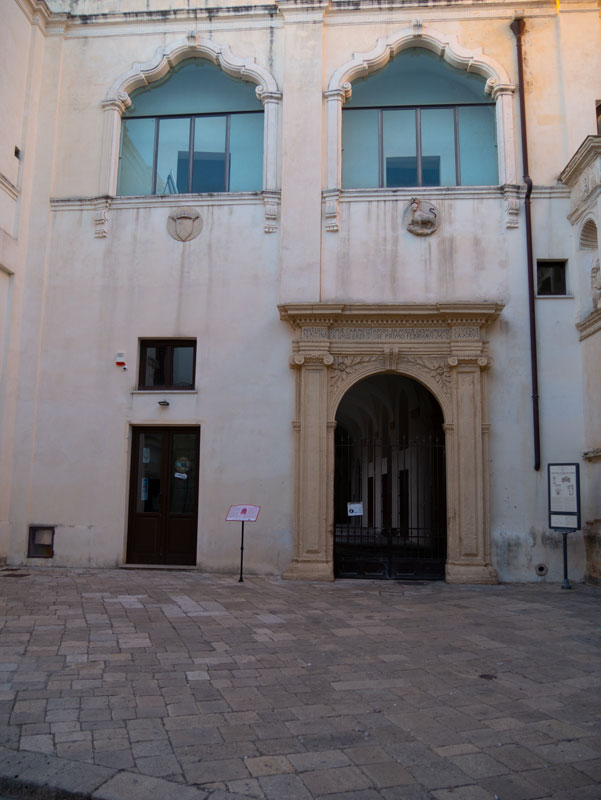
The Palace of the University of Nardò, known today as the Palace of the Magistrate’s Court, dates back to the 16th century. The elegant façade is in late Baroque style, with two orders: the lower one consists of seven columns and a portico while the upper one is characterised by windows, corbels and refined floral motifs. Located in the beautiful Piazza Salandra, the Palazzo dell’Università is the building that houses the famous clock tower.The Hosanna
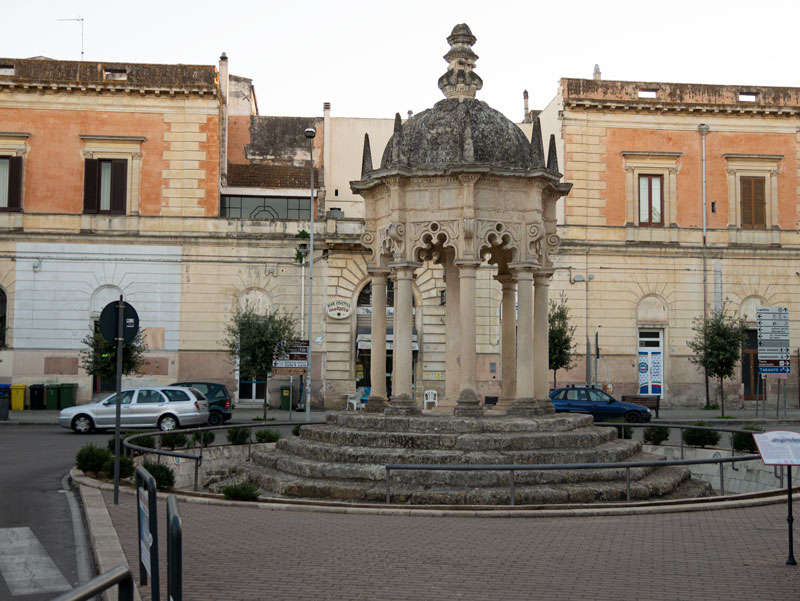
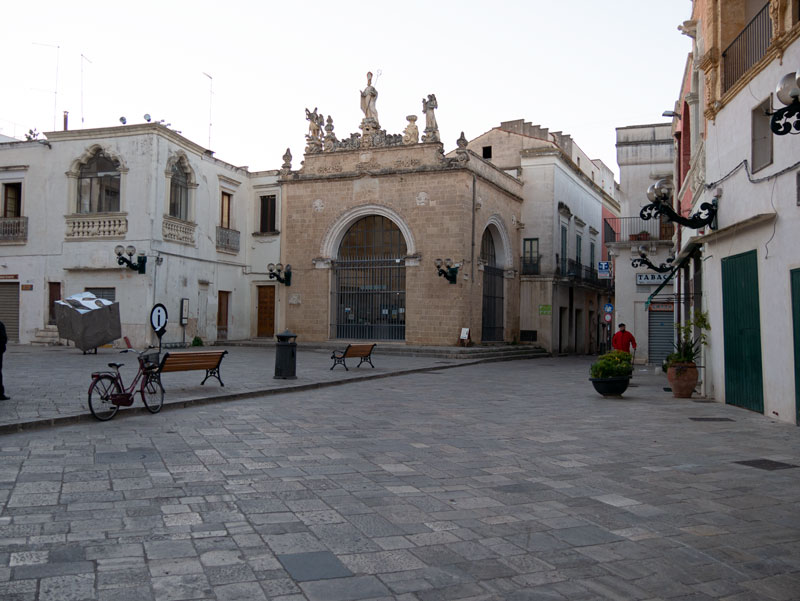
The Tempietto de l’Osanna, built in 1603 in full Baroque style, is strategically located on the outskirts of Nardò’s old town, towards the road to Lecce. The small temple consists of eight columns supporting a dome and is octagonal in shape. The almost oriental monument stylistically is a kind of canopy and is still used by the bishop to bless olive branches on Palm Sunday.The Bull Fountain
A very recent construction, the Bull Fountain was created in 1930 by Michele Caballo, a sculptor from Nardò. The fountain represents and interprets the coat of arms of the town of Nardò: a bull digging into the ground meets water, a source of wealth for the local economy.The museums of Nardò
What to see in the Salento metropolis The great city of Nardò not only has fascinating architecture but also offers the possibility of visiting various museums that bear witness to the different cultures and civilisations that have settled in the Nardò area. In this beautiful city, one does not live by the sea alone, and carving out a moment for a cultural exploration can make you appreciate the Salento holiday spots even more.Museum of Memory and Hospitality
The material housed inside this museum dates back to the period from 1943 to 1947, when Nardò and Santa Maria al Bagno gave refuge to 150,000 Jews fleeing the Holocaust. There are videos and photographs, a library and newspaper library, a multimedia room and three murals. The latter, created byRomanian Jew Zivi Miller, a refugee in Nardò after escaping the concentration camps, are a poignant testimony to the Jewish extermination.Children’s Archaeological Museum
There is no shortage of activities for children in Nardò, where they can play immersed in culture. Known in fact as the Tactile Museum, inside the building it is possible to reconstruct archaeological objects in experimental archaeology workshops.Sea Museum
The Museo del Mare (Sea Museum) in Nardò is an interesting exhibition of amphorae and objects found on the coast, belonging to Roman ships. You should know that the Salento and its sea hide treasures of inestimable value.Didactic Museum of Prehistory
The Educational Museum of Prehistory in Nardò allows you to get to the heart of the prehistoric era, with the human and animal fossils inside, the instruments used by speleologists for research, and the large photographs and illustrations representative of the period.The beautiful marinas of Nardò
What to see and do in these fabulous places The marinas of Nardò are dreamy places with picture postcard beaches and are popular destinations for tourists who choose the Salento in summer. Nardò has beautiful marinas:- Santa Caterina di Nardò;
- Santa Maria al Bagno;
- Sant’Isidoro;
- Torre Inserraglio;
- Porto Selvaggio, Torre Uluzzo, the Natural Park and Palude del Capitano.
Santa Maria al Bagno
Dream sea and nightlife in Salento At a distance of 7 km, Santa Maria al Bagno is a hamlet of Nardò with only 950 inhabitants in winter. Caribbean beaches with fine, light-coloured sand alternate with enchanting cliffs. In addition to having a beautiful, clean sea, Santa Maria al Bagno is also a place of attraction and Salento’s movida, a meeting place for young people who like to have fun in a healthy way.The Salento Aquarium
TheSalento Aquarium is an interesting attraction for adults and children, 350 square metres in size and with 22 different aquaria inside. The building allows visitors to admire the flora and fauna typical of the seas around Salento.The Four Columns
The Four Columns are an architectural spectacle a stone’s throw from the sea of Santa Maria al Bagno. The four seventeenth-century columns, symmetrically arranged and identical, are what remains of a military architecture, built to defend the territory from the attack of Saracen pirates from the sea. The coastal part adjacent to the war building is also called Quattro Colonne. Today, Quattro Colonne is home to an exclusive disco pub popular with Salento residents and tourists alike.Santa Caterina
Santa Caterina is the second most populated marina in Nardò, after Santa Maria al Bagno. It is abeautiful coastal resort where one can spend a holiday in total relaxation and immersed in history. In fact, as in most of the seaside resorts of the Salento, military architecture can be found here.The Tower of Santa Caterina
The Santa Caterina Tower, built in the 16th century, is surrounded by a dense pine forest. It has a special structure compared to traditional towers because it has a long staircase leading to the entrance on the upper floor. The purpose of this construction was to defend against maritime attacks.The Alto Tower
The Santa Maria al Bagno Tower, located 51 metres above sea level, stands very close to the coast for defensive purposes. Also built in the 16th century, it was commissioned by the Spanish viceroy Don Pietro di Toledo.Sant’Isidoro
The seaside resort takes its name from the Sant’Isidoro Tower, a carparo tower built in the 16th century on the sandy shoreline. The small town has developed recently, but Sant’Isidoro is mostly frequented during the summer by the people of Nereto, the inhabitants of Copertino and the many tourists who choose a quiet place to stay.Porto Selvaggio – Torre Uluzzo, the Natural Park and the Captain’s Swamp
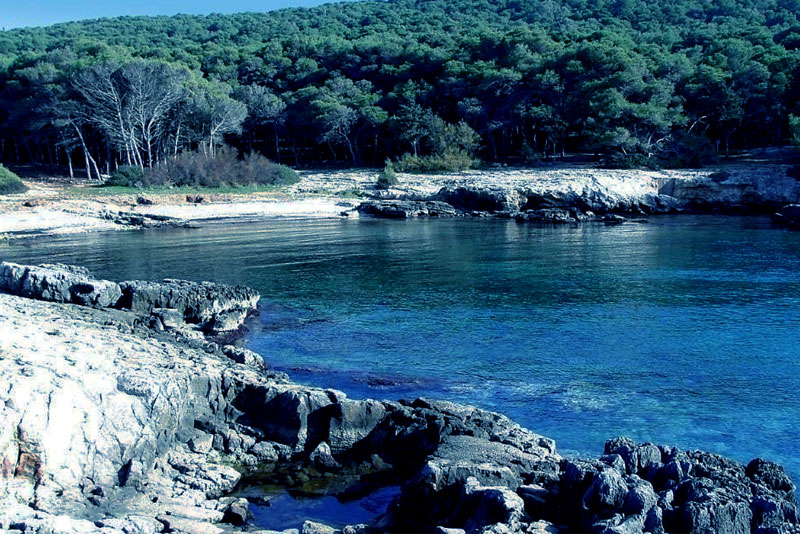
The Porto Selvaggio Natural Park and the Palude del Capitano (Captain’s Swamp) have been included by the FAI, the Fund for the Italian Environment, in the 100 places to safeguard. The Palude is also classified as a Natural Area. These two natural beauties to visit and admire are located in the territory of Porto Selvaggio, a seaside resort characterised by jagged rock and many pine forests, including various species of the Mediterranean maquis.Where to eat in Nardò
The places to eat in Nardò are many and all different to satisfy every palate and every culinary need. Eating in Salento is always a unique experience and Nardò offers a wide choice: from the excellent coffee at Caffè Parisi to the delicious meat at Macelleria Fai. Every place is a place of food and incredible encounters that make the city of Nardò Porta di Mare unique.Schola Sarmenti
Local cuisine and Apulian wine in an elegant location Schola Sarmenti is a high-quality Apulian wine and wine bar. The wine bar located inside the wine shop offers traditional Apulian cuisine, made with genuine, seasonal products, as provided for by the Mediterranean diet and rich in the typical flavours and aromas of Salento. All accompanied, of course, by the excellent, internationally award-winning Schola Sarmenti wines.La Dispensa dei Raccomandati
A seafood trattoria in the historic centre of Nardò For those who want to eat fresh fish and raw seafood, a visit to the Dispensa dei Raccomandati is a must. Located in the historic centre of Nardò, this restaurant offers seafood specialities, created by a great chef capable of combining tradition and innovation in each of his dishes. In autumn and winter you can also enjoy delicious pizzas.Art Nouveau Restaurant: eating good fish in Santa Maria al Bagno
A 19th century palace by the sea and a refined cuisine of only fresh and tasty fish, the Art Nouveau Restaurant is all this. Eating typical Salento flavours with a sea view is a unique experience not to be missed in Salento and Art Nouveau, on its terrace, can make you experience this magic.Fai Butchers
Butchers from generation to generation The place is magnificent because we are in the heart of the historic centre of Nardò, 10 metres from the splendid Piazza Salandra. The owners of Macelleria Fai, butchers for several generations, with great pride and pride, from the refrigerated counter, suggest the best meats. You can choose from bombette, scottone and angus grass fed. For people like us who love meat as well as seasonal vegetables, this place is ideal for a fine dining experience. Dulcis in fundo, we recommend the desserts prepared by the owner’s wife: one better than the other.Café Parisi
After a hearty lunch or a tasty dinner, coffee is a must. We recommend thecoffee experience, yes because we are not talking about a simple cup of coffee, but about history, selection of blends and the culture of Arabica. It is no coincidence that you can visit the Parisi Coffee Museum here, taking a real journey through the aromas of coffee plantations in remote parts of the world! PS: sweets and spumoni here are no less! Super-recommended place, Caffè Parisi is one of our magic spots for a proper coffee break!Where to stay in Nardò
Bed & Breakfast, hotels and luxury relais a stone’s throw from the sea Those who want to stay in Salento, a stone’s throw from the sea, often choose the Ionian coast, rich in enchanting inlets where they can admire the sun setting into the sea every day. Nardò Porta di Mare offers attractive solutions for your stay in Salento.Grand Hotel Riviera in the charming marina of Nardò Santa Maria al Bagno
Equipped with every comfort, the Grand Hotel Riviera, is a unique and perfect place for young and old. Located on the seafront in Santa Maria al Bagno, it is ideal for those who want to relax and pamper themselves away from the hustle and bustle of the city. The hotel also offers a beautiful swimming pool, an excellent restaurant and a lounge bar to enjoy a drink in front of the sea.Relais Il Mignano: sleeping romantically in the historic centre of Nardò
A restaurant and hotel housed in a medieval building, Relais Mignano is an elegant historic building in the centre of Nardò. The rooms are equipped with every comfort, cosy and ideal for a romantic holiday.Masseria Pagani Resort & Relais: a holiday immersed in the green Salento countryside
An old Masseria immersed in the countryside is just what you need for a truly regenerating holiday. Masseria Pagani, located on the outskirts of Nardò, allows you to experience an alternative holiday in a Salento oasis. The spacious and cosy rooms, the swimming pool in the garden and the delicious Italian breakfasts home-made by the owner are three of the reasons why it is impossible not to choose it.Corte San Giuseppe Bed & Breakfast
Corte San Giuseppe Bed & Breakfast is located in the heart of the historic centre of Nardò, between the ancient square and Acquaviva Castle. This cosy little place is an example of medieval architecture in Salento. Inside, just like in an artisan’s workshop, you will find among the furnishings the work tools of bygone eras. If you love quiet holidays and peaceful places to stay, this b&b in Nardò is the ideal place for you.Il Cubo: romantic loft in the heart of Nardò
This is one of our places of the heart because it represents two special people: Alison and Phil, husband and wife, directly from Colorado (USA) who, in love with Salento, decided to renovate this gem in the heart of Nardò so that they could spend their holidays here when they could. Throughout the year, this romantic bed & brakfast with its panoramic terrace overlooking the Baroque, welcomes visitors from all over the world curious to get to know the Salento and appreciate its flavours and knowledge.The weather in Nardò
Plan your holiday in Salento with the sun.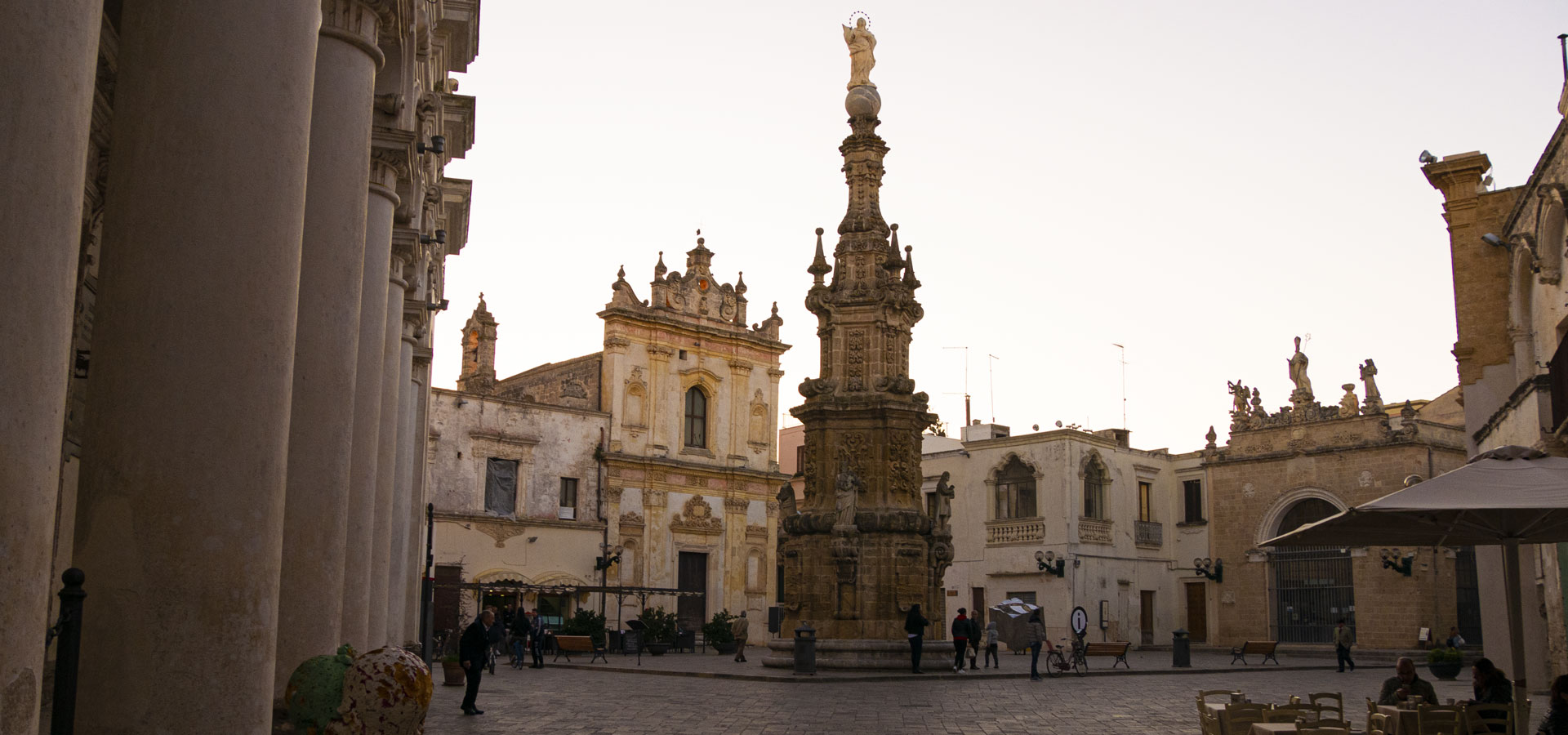
Ultimi Articoli su Nardò

Churches and monuments of Nardò, jewel city of Salento and Apulia
Nardò, Porta di Mare and enchanting town in Salento and the heel of Puglia, in the province of Lecce, boasts ancient origins, and its history, full of twists and turns, has seen the succession of different foreign powers.
Nardò Porta di mare: what to see in the city of Nardò
Nardò is the second largest municipality in the province of Lecce (capital of Salento) both in terms of territorial extension and number of inhabitants. It boasts very ancient roots that date back to the Paleolithic period, as evidenced by graffiti and archaeological finds found in one of the many characteristic caves in the bay of Uluzzu.
Nardò, Porta di Mare: the best restaurants
Nardò, the second largest municipality in the province of Lecce in terms of both population and land area, is one of the many pearls scattered
The best hotels, relais, villages and cottages by the sea in Nardò (Porta di Mare)
Nardò, the second largest municipality in the province of Lecce (Salento’s provincial capital) in terms of population and land area, is a popular tourist spot
Nardò: the best masserie in Salento.
Once peasant houses, now structures of great charm and charm, the masserie of Salento are now the most sought-after places for exclusive, open-air vacations: rural