Nardò, Porta di Mare and enchanting town in Salento and the heel of Puglia, in the province of Lecce, boasts ancient origins, and its history, full of twists and turns, has seen the succession of different foreign powers. The town, which covers an area of almost 190 sq. km, is a short distance from the Ionian coast and is inhabited by about 32,000 people.
The territory, extremely chameleon-like, offers enchanting views in which nature and the crystal clear sea explode with all their power; there is also no shortage of sites of unparalleled historical and cultural value.
The places to visit are truly countless and the list cannot fail to include museums, archaeological areas, houses of worship, monuments and the wonderful beaches lapped by turquoise waters.
The main churches of Nardò: masterpieces of Lecce Baroque, priceless pearls
During your tour in Nardò you absolutely must go to the most important churches of the well-known Salento town.
These are artistic monuments of inestimable work, shining examples of the very famous Lecce Baroque that characterizes the monuments and churches of the centers of the Salento peninsula.
Structures are scattered throughout the city, and among those worthy of your full attention, we recommend visiting:
- the Cathedral Basilica of Santa Maria Assunta,
- the Church of San Domenico
- that of the Madonna del Carmine.
The Cathedral Basilica of Santa Maria Assunta: frescoes and a wooden crucifix are the distinctive elements of this splendid masterpiece
The complex, probably erected in Norman times on the ruins of the old Basilian church of Santa Maria de Nerito, has undergone several restorations and everything around you dates back to the 18th century.
The exception is the frescoes on the high altar, which bear the signature of Cesare Maccari and were made in the early 20th century. One of the most interesting pieces is, without a shadow of a doubt, the Black Crucifix, a wooden statue, which owes its particular coloring to the cedar wood used.
Anancient legend has it that the work, produced between the fifth and sixth centuries, lost blood during the attempted theft enacted, in 1255, by the Turks, who, faced with this circumstance, allegedly decided to beat a retreat.
The Church of St. Dominic
The layout of the sacred building, erected in the 16th century and initially named after Santa Maria de Raccomandatis, has been modified over the years, and the three interior naves have been replaced by a single hall for preaching needs.
The church, destroyed in the 1743 earthquake, was rebuilt almost in its entirety: in fact, the side wall, sacristy and facade were only partially saved.
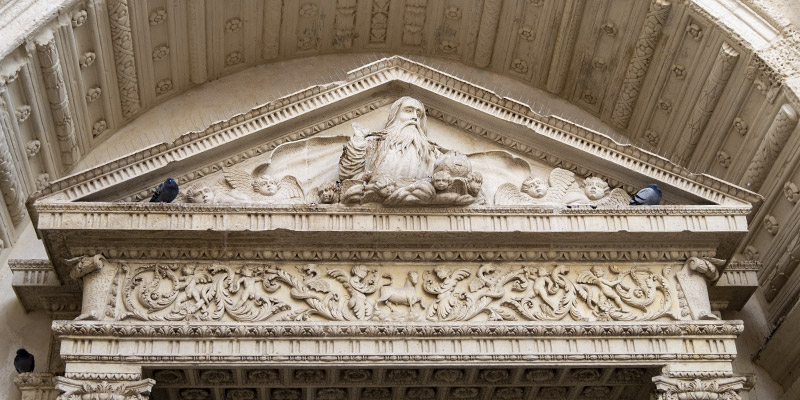
The facade, in particular, has always aroused the curiosity of many people by virtue of its decorations: the upper part is almost bare of ornamental elements, while the lower part is rich in figures of various kinds, but none of them can be traced back to precise earlier models.
The Church of Our Lady of Mount Carmel
The structure and the nearby convent constitute one of the best-known monastic complexes in Nardò. On the facade, which encloses all the Romanesque style, you can admire two niches that house, respectively, the statues of the Nunziante Angel and the Virgin Annunziata, while the entrance is protected by two lions. Theinterior, enriched with Baroque stuccoes, holds works of great value.
Nardò’s most important monuments, Porta di Mare
Nardò, a renowned cultural center, houses several Baroque and Romanesque-Gothic works.
There are many monuments to admire, but must-sees include:
- the Hosanna,
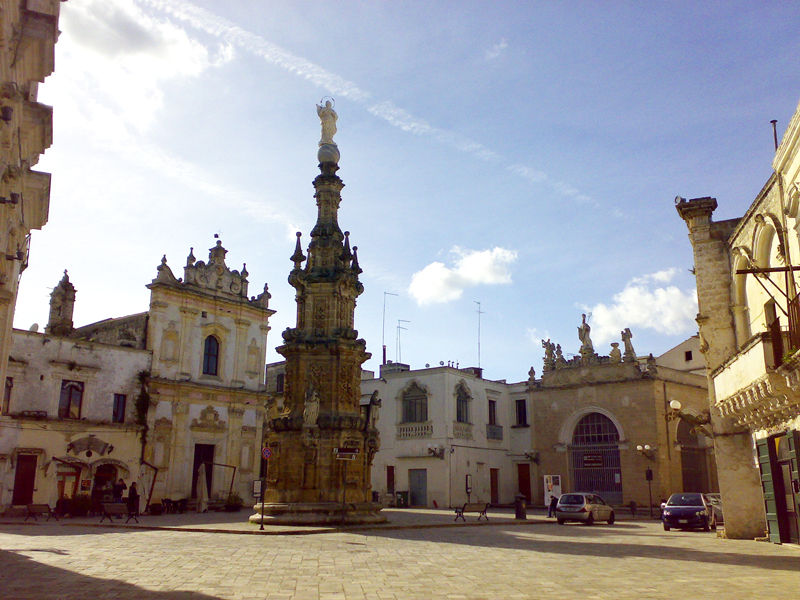
- the Spire of the Immaculate Conception
- the Bull Fountain.
Finally, if you have time, I suggest you take a look at the watchtowers that were used, in past centuries, to prevent possible enemy raids.
The Hosanna
The historic center welcomes you with thisstriking work erected in 1603 and made entirely, in the seventeenth-century style, with Lecce stone.
The monument, octagonal in shape, consists of a central column, which supports the dome, and is surrounded by eight as many elements.
The latter, according to the most credited hypothesis, were added at a later time thus giving the Hosanna the title of Christian symbol.
The Spire of the Immaculate Conception
It was built, as an engraving reports, at the behest of the population following the earthquake that shook the entire Salento region in 1763.
The column, 19 meters high in total , is made of carparo, a local yellowish-colored stone, and has five different levels that end with the globe supporting the Madonna. At the first order you can notice the statues of St. Joseph, St. John, St. Dominic and St. Anne.
The Bull Fountain
The protagonist of the fountain, the work of sculptor Michele Gaballo, is a bull, symbol of Nardò. In fact, an old legend says that the town was founded on the exact spot where this animal made water gush, but at the same time it also represents the Spanish Aragonese who came to Salento during the Renaissance.