The city of Otranto in Salento has all the makings of an ideal destination for your next vacation. The all-inclusive package it offers you includes sunshine, crystal-clear waters, fabulous beaches, valuable historical and cultural heritage and, to top it off, a rich food and wine tradition. Now, let us take you by the hand and guide you to discover Otranto and its historic center.
If you want to get to know the city of Otranto and taste its artistic and gastronomic delicacies, we have the experience for you“”Urban Trekking in Otranto: its beauties and its lighthouse”. An unforgettable experience that will allow you to get to know in depth the artistic heritage of this magnificent pearl of Salento, just a stone’s throw from the city of Maglie.
A quick overview of Otranto, flagship of Salento
Otranto is located on the Adriatic coast of the Salento peninsula, dominates the sea from the rock on which it lies and can be roughly divided into two parts. The first, which houses the old town, is protected by the Aragonese walls, is totally pedestrian and is crisscrossed by narrow streets and alleys that make you relive the past atmospheres of this wonderful locality.
If you love shopping, you cannot, moreover, not take a look at the stores: this may, in fact, be the right opportunity to buy some local products or souvenirs to take home.
The second, newer one winds along the waterfront and hosts many businesses, bars, ice cream parlors and restaurants.
The historic center of Otranto
The historic center certainly represents the beating heart of the well-known Salento town; what are you waiting for, then, to discover the most characteristic alleys and corners? We now offer a small taste of what awaits you.
The Alfonsine Gate
Your tour can only start from the Alfonsina Gate, which is the actual entrance to the ancient town.
The Ottoman troops, back in 1480, launched a tremendous attack on the city, which was completely destroyed; the invaders were, however, driven back thanks to the intervention of the allied troops led by the Duke of Calabria Alfonso D’Aragona.
Therefore, a long reconstructive phase began, the project of which was entrusted to Ciro Ciri, who had, in addition, built on the polygonal plan of the city walls the gateway to the historic center, which by its name is intended, also, to pay tribute to the advocate of Otranto’s liberation.
On the top you can see an opening whose particular location allowed the throwing of hot liquids toward those who attempted to besiege the city. This opening is called a barbican.
The Byzantine Church of St. Peter
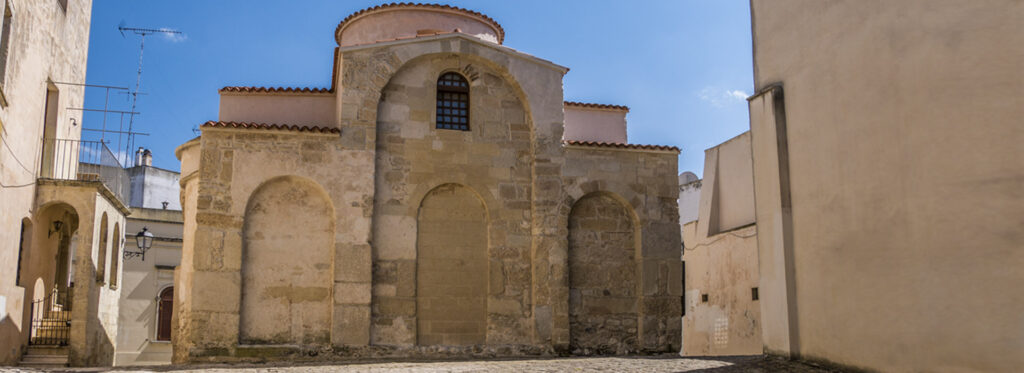
The Church of St. Peter is, at least in part, an expression of the Byzantine building tradition in Salento.
We have already discussed this splendid example of Byzantine architecture in more detail in this post “Otranto: Byzantine Church of St. Peter”
In the building, with a cross-shaped plan, there are, in fact, several references to this population: one of the main elements used in its manufacture is a special cement made of sand lime and inert material. Other parts deviate, however, from the criteria of Byzantine manufacture, and among them are the columns and vaults that appear irregular.
Inside you can observe some of the frescoes preserved along the walls such as, for example, The Washing of the Feet, The Last Supper, The Betrayal of Christ, The Nativity and Arrival of the Magi and many more.
And finally a curiosity: it is said that the founder of the church was St. Peter who, on his return from a trip to the East, baptized the Idruntini (the inhabitants of Otranto, from the Hydro River) and had the eponymous place of worship erected.
Otranto Cathedral: the cathedral mosaic and the Holy Martyrs of Otranto await you with open arms
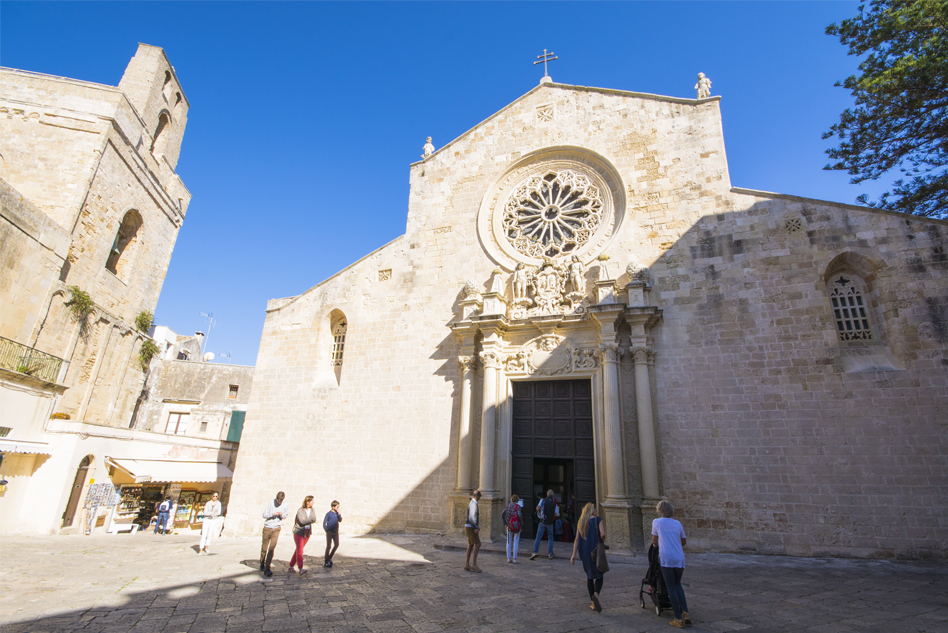
The Cathedral of Santa Maria Annunziata was built back in 1088 on the foundations of an old temple and was consecrated the same year by Pope Urban II.
Byzantine, Romanesque and Gothic elements blend harmoniously in the building; observing the facade you may notice a Baroque portal from 1764 and a marvelous rose window dating back to the Renaissance. The latter consists, in turn, of a central core, in Gothic style, and 16 small columns arranged radially around it.
The roof, covered with wood, boasts some precious gilded decorations; moving inside you can appreciate a single room divided into three naves by marble and granite columns.
Take a look at the Byzantine-style frescoes adorning the walls, and don’t forget to visit the 11th-century crypt.
The highlight certainly remains the Floor Mosaic located in the main nave, representing the Tree of Life and consisting of more than 600,000 pieces of limestone origin.
About the cathedral, its mosaic, we have already told you in this post “Otranto: quick guide to the cathedral ” .
Of the fascinating crypt where St. Francis and Dante Alighieri are said to have passed, we told you about it in this post “Discover the crypt of Otranto Cathedral”
The Castle of Otranto
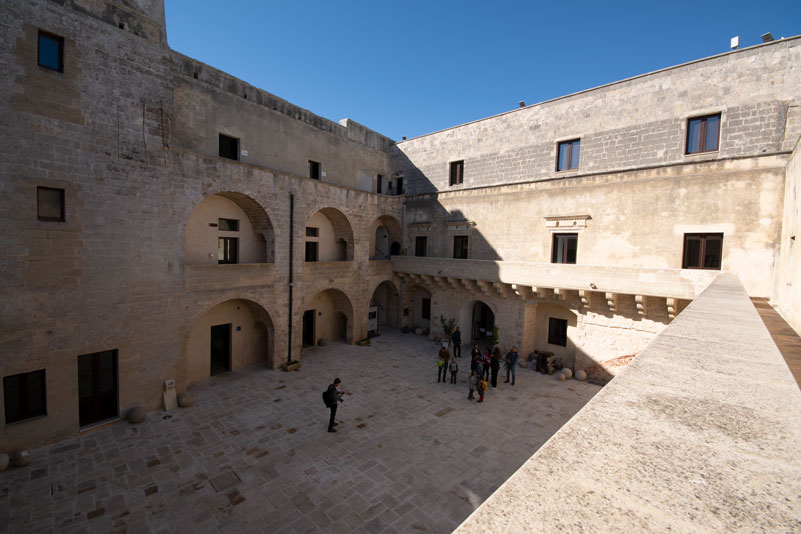
The Aragonese Castle has a past as a defensive stronghold, but today it is one of the city’s major attractions and national and international events are very often held there.
It owes, moreover, part of its fame to the literary universe because the first Gothic novel in history, signed by Horace Walpole, is entitled precisely “The Castle of Otranto.”
The history of this building has always been very troubled and, in fact, in the past it was subjected to various interventions of which it still bears the marks.
What you can currently admire is the result of the work of the Spanish Vice Kings who transformed the structure into a true example of military architecture.
The pentagonal-shaped castle boasts two polygonal bastions, a vast moat, four towers (three circular and one with a point facing the sea) and a drawbridge.
Noteworthy details include the Alfonsina, Duchessa and Ippolita towers, the Punta di Diamante bastion , but especially the Triangular Hall.