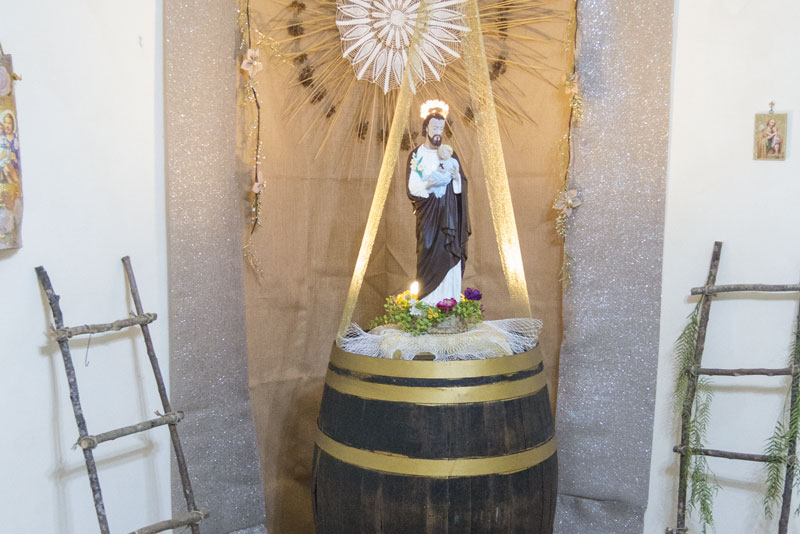
The Tables of St. Joseph in Giurdignano (and also in other neighboring towns in Salento and Terra d’Otranto) are a shining example of how peasant civilization, faith and devotion to the Protector of the Holy Family merge into a unicum.
Peasant tradition, faith, devotion, and community logic are the driving spirit behind the preparation of St. Joseph’s tables. Let us try to explain why.
If you would like to see up close the final preparations of the Tables and learn about the recipes and have a little taste, after visiting the cozy town of Giurdignano, a little gem between Otranto and Maglie, YOU MUST REGISTER FOR OUR EXPERIENCE ON “THE TABLES OF SAN GIUSEPPE IN GIURDIGNANO”. FEW PLACES AVAILABLE!!!
St. Joseph’s tables: brief historical background
Imagine going back in time. Historical sources and curia documents, attest to the first forms of popular devotion to the saint, around 1500. Around the late 1600s, from an inventory of parish property, the cult to St. Joseph is mentioned, and a proper altar is built to him.
The transition from the Greek to the Latin rite marks the devotion to the saint.
In the second half of the 1700s, in some of the writings of the time, the need for a larger and more welcoming church was manifested, because, during the celebrations in honor of the saint, the Matrix church could not contain the large number of worshippers.
So the presence of the relics and the construction of a new church for that purpose set the community spirit in motion for the construction of a new church, significantly larger and more welcoming (1756), completed and finished in 1759. Thus the church of St. Savior was born, and the Personé family, donated the painting of the Holy Family that you can admire in the Matrice church. Inside, you can find the Holy Relics of St. Joseph, Our Lady and St. Fortunato.
The first statue of St. Joseph: we are in the 19th century
The increase in the cult of the saint is evidenced by the presence of a valuable statue of St. Joseph, dating back to the 19th century, inside the Matrix Church.
St. Joseph’s Table: a true devotional banquet
St. Joseph’s “tables” are found in several places in southern Italy-Sicily, Molise, Abruzzo and in Lizzano (Taranto).
They are a sacred banquet, that is, a vow of thanksgiving to St. Joseph for a grace implored and received by a person who has committed himself to the Protector of the Family with a vow.
The food offered is a sacred meal against famine, starvation, and death.
The Tables are addressed to the saint to secure his divine benevolence.
Of the first charitable lunches, Galantine (1444 – 1517), a humanist physician for the feast of St. Luke, speaks of it; he offered a meal to the poor.
This purpose was later transferred to St. Joseph, the Protector of the Poor.
The different types of St. Joseph’s Table united by devotion and worship to the saint
St. Joseph is revered as the Dread of Demons, the Family Protector of artisans and the poor, especially the needy from the farming world.
In fact, he is the Saint who drives away famines by allowing exceptional harvests, thus ensuring the abundance of crops.
For this reason, in several homes, real small altars are erected to obtain from the Saint the healing from an illness, the guarantee of work (St. Joseph the Worker) and the obtaining of a good harvest.
And it is the Saint himself who asked for the setting up of the Table, appearing in a dream and, of this, we have given testimony, in the video interview made with Mrs. Lisa.
The types of Table
There are several types of St. Joseph’s Table:
- Tablets for devotion;
- Tables for bequest;
- Peasant boards;
- Cooked tables;
- Uncooked Tables.
Tables by devotion arise precisely because of the intervention of the saint who, appearing in a dream to the person concerned, requests the setting up of the Table. The Table by devotion is never interrupted for fear of St. Joseph’s reaction.
The Tables by bequest are passed down from mother/father to daughter/son upon the death of the parent.
Generally these are Tables by devotion that turn into Table by bequest and, the family members of the deceased, continue to prepare them so as not to fail in their devotion to the Saint and not to disrespect the last wishes of the parent or close relative.
The other form of vow is the Tavola pezzente i.e., that table set and prepared with alms: bread, wheat, oranges, wine, oil, chickpeas or small cash offerings received from neighbors, relatives and strangers.
Rich and poor alike, barefoot, knocked on the doors of their neighbors in the name of St. Joseph to ask for alms.
“Essi te casa toa e tuzza alle porte e vidi ca se aprene” (Elisabetta Rubrichi dreamed of the saint telling her this, “Get out of your house, knock on the doors of your neighbors and you will see that they will open.”) This is because St. Joseph is good to all and grants to all.
Cooked Tables are those where the foods are cooked while raw tables are those where all the foods displayed, although raw, reflect the folk and devotional tradition and represent traditional dishes.
The spirit of the peasant community and their industriousness in organizing: the famous “St. Joseph’s nuisance”
“St. Joseph ‘ole u fastidiu,” the saint wants people to strive for the good organization of the Table with a sincere heart.
Peasant families in the period of the first Tables well know the meaning of the word “fastidiu.” The peasant civilization of that time lived in extreme poverty. Little food, little money, a lot of poverty and misery.
The Saint’s dream, however, activated in them a great spirit of sacrifice because the poor people of Salento were ready to sacrifice themselves in everything in order to fulfill the Saint’s request. They would give up the best produce of the land in order to offer it to the “Holy” diners. All this was done with great humility and great devotion.
In the houses they worked day and night non-stop. The Salento housewives, under the watchful eye of the mistress of the house, kneaded, cooked, sautéed and washed as if on an assembly line, impeccably.
The brotherhood, the sharing of sacrifice and the spirit of community made the preparation of the Table unique because being united in the little, nurtured a strong spirit of brotherhood.
The humblest homes were transformed into splendid altars thanks to the festive decorations, the flowers, the finely crafted table cloths of the trousseau. And this spirit and devotion can still be felt today.
St. Joseph’s Table: the dishes
St. Joseph’s Tables can be set up for an odd number of Saints (to recall the Trinity and the number 3): starting from three Saints (Jesus, St. Joseph and the Virgin Mary) up to thirteen Saints (like Mrs. Lisa’s table).
The dishes are as follows:
- Wheels of bread (5 to 7 kg in weight) marked with a specific symbol;
- Pampasciuni (cooked or raw lampascioni in oil);
- Foje (turnips, chicory or cabbage);
- Vermiceddhri (vermicelli): homemade pasta;
- Pasta cu lu mele (pasta with honey breadcrumbs);
- Chickpeas cooked in pignata;
- Stoccapisce cu li spunzali (stockfish with wild onion);
- Fried fish;
- Pittule (pettole);
- Honey-fried: carteddhrate (cartellate) and purceddhruzzi (struffoli);
- Raw fennel;
- Orange
- wine;
- oil
Since this was a holiday that always occurred during Lent, abstention from meat was Christianly observed, and for this reason, you will not find meat, eggs and dairy products on the Tables.
The bread for each Saint is distinguished by a symbol
The loaves of the Holy Family, are placed in the center of the table. All the breads on the Table of St. Joseph, are easily recognized because they are marked by symbols:
- the flowering rod, recalls St. Joseph’s staff, and on the wheel of bread dedicated to him, this symbol is shown;
- three small loaves recall the Holy Trinity and are shown on the bread of the Infant Jesus;
- the Holy Rosary: this is the bread of the Blessed Virgin Mary;
- the palm tree: this recalls the bread of the Saints who will sit next to the Holy Family;
- a simple staff recalls the bread of the Holy Commensals;
St. Joseph’s Tables: who are the Holy Diners of Jesus, Joseph and Mary
Diners before taking part in St. Joseph’s Table, after being chosen by the hostess on the day in honor of the saint (March 19), must go to confession and take communion.
Generally, the Tables are arranged for a number of saints ranging from three to thirteen.
Therefore, in addition to Jesus, Joseph and Mary, 10 saints will sit at the table.
The number thirteen because it is reminiscent of the Last Supper is reminiscent of the twelve apostles with Jesus.
The sampling of the dishes begins with the ritual expression “San Giuseppe te l’aggia ‘nsettu” or St. Joseph may he appreciate your sacrifice and grant/hear your request for Grace.
The Saints present at the table generally include the following:
- St. Joseph, the Virgin and the Child Jesus;
- Mary’s parents St. Joachim and St. Anne;
- her cousin St. Elizabeth and her husband St. Zechariah;
- St. John the Baptist, cousin of Jesus and son of Elizabeth and Zechariah;
- St. Lazarus and St. Martha, Jesus’ close friends;
- the pious women, St. Mary of Cleophas and St. Veronica;
- Saint Joseph of Arimathea;
Or other saints can be found such as:
- sometimes replacing some apostles such as St. Philip, St. James;
- St. Agnes or St. Anthony depending on the devotion of the family hosting the Table.
The older man impersonates St. Joseph, the younger Jesus Child, an unmarried girl the Virgin.
Guests at the Table cannot refuse lest they cause offense to the Saint.
Curiosity regarding guests
The invitation to attend the Table often became an occasion to settle disagreements and quarrels between family members or with the neighborhood. The Tavola represents a true moment of reconciliation with one’s neighbor.
St. Joseph is the first to sit at the Tavola and, his place, is marked by the flowered rod, “u bastone de San Giuseppe.”
To his left, in order, are the Infant Jesus, the Virgin and the Holy Family’s closest relatives, and finally all the other Saints.
With a stroke of his staff he starts the meal while, tapping the prongs of his fork on the plate, he invites all the diners not to touch that food again.
When the meal is over, the devotee kisses and passes the wheels of bread to St. Joseph who, in turn, blesses them with a kiss and hands them, according to the symbol on them, to the diners.
Each saint, at the end of the meal, must collect all the food prepared for him.
The diners thank the devotee with the expression “San Giuseppe cu te esaudisca” (St. Joseph who hears you).
St. Joseph’s Table is devotion and sharing.
The common thread that accompanied our research on the study of the Tables of St. Joseph is this: devotion, the vow made and the sharing “du fastidiu” with those who help the hostess in the preparation, are the spirit that animates and moves the community of Giurdignano for this very important event. We recommend you watch our video and participate in our experience “Tables of St. Joseph in Giurdignano”